How to Upload Several Blog Posts Together Wix
Updated September 2021
H1 Heading Tags for SEO
When you read a book or a mag, every chapter or article starts with a title.
That's true even for the web, where a title on the page is called an h1 header.
However, please don't confuse the "title on the page" with the <title> tag! The latter is a part of the HTML code of the page that tells browsers to display a text (a title, indeed) in the top bar — a text that is often used by search engines as well to show a title in search results. The title may or may non be the same text as your h1 header.
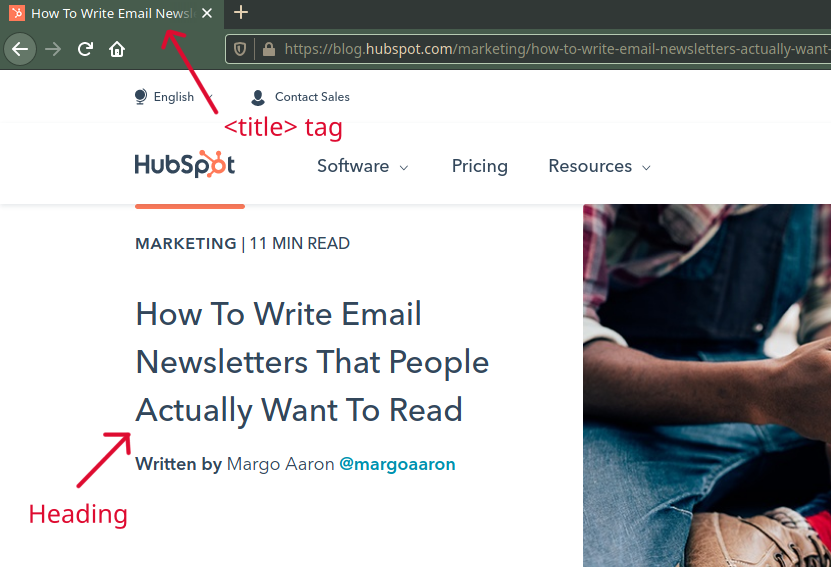
In this mail, you'll learn almost what h1 headers are, why they are important and how to create them on your site using platforms similar Weebly, Wix, Squarespace, Shopify and WordPress.
If yous desire to skip to a specific section, below is the card. Otherwise, just first reading!
Skip Directly to:
- What are H1 Headers?
- Why are H1 Headers important?
- How to add together H1 tags in Weebly?
- How to add H1 tags in Wix?
- How to add together H1 tags in WordPress?
- How to add H1 tags in Squarespace?
- How to add H1 tags in Shopify?
What Are H1 Headers?
You may have heard the words "main header" or "heading tags".
These are also known as h1 tags, and you can recognize them because unremarkably they appear as the largest text on your folio, and can also act as the championship of your page or post.
Nosotros call them "tags" because they announced as parts of the HTML language that give commands for displaying information in web pages. These elements of the HTML language are called tags and appear between angle brackets: <…>.
H1 appears in HTML code as <h1> — therefore it'south a tag.
The screenshot below shows how it looks similar in the HTML code of a page:

(Note: the class="entry-title" in this example is meant to fashion the h1 header in a particular way. When yous look at the HTML code for an h1, it may have no 'class' at all, or yous may come up across different form names. Don't worry about that at present.)
H1 is not the merely heading tag, though. There are 6 levels, from h1 to h6, that form a top-down bureaucracy. The most important one is the h1 tag and the least of import is the h6 tag.
Ideally, y'all desire to have a heading structure that flows and makes sense both from a design and SEO point of view. Nonetheless, nothing horrible will happen if y'all start with an h1 tag followed by an h4 tag, or if you accept multiple h1 headings.
While this is generally considered a bad exercise from a design viewpoint — likewise as making information technology harder for screen readers used past visually impaired people, so yous may want to avoid it for their sake — your concluding goal is "making sure the content is organized in a practical and sensible manner", every bit stated in this Search Engine Journal article.
That means that a correct heading construction is always preferable, only when in incertitude you lot should aim for user experience and a coherent content organization.
Now, for an example of "correct construction", y'all can call up about how chapters and subchapters in a nonfiction volume are organized, or you tin accept a wait at the following taxonomy to get an idea of the relative importance and semantic bureaucracy of tags:
- Organism would be like <h1>
- Animal would be <h2>
- Mammal would be <h3>
- Carnivore would be <h4>
- Canis familiaris would exist <h5>
- Beagles would be <h6>
You start with the broad, and you end up with the more specific.
Why Are H1 Header Tags Of import?
It's simple: h1 headers matter because they are one of the things search engines similar Google or Bing scan in club to understand what your site is well-nigh.
In fact, the "h1" describes the topic of the post or folio, and together with other headers, it indicates the structure of the page or mail service.
Also, h1 header tags are important for the bodily visitor of your page, who will run across the header as a articulate indicator of what the page content is about.
What Does the Task Look Like in marketgoo?
In marketgoo, this task falls within the Optimize section.
In one case you choose the keywords you want to focus on, you will optimize each page and postal service on your website for those keywords. In marketgoo, if your h1 header is not optimized, you will get a recommendation to accept it include ane or more of your focus keywords.
See the screenshot below:
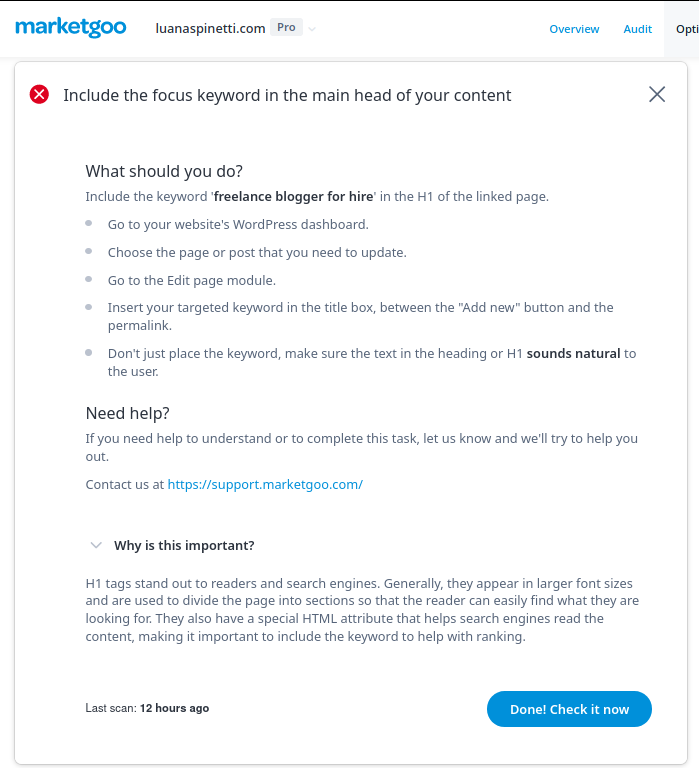
Every bit yous can run into, marketgoo can detect your missing titles, h1 tags and tells y'all how to insert them in your site. To observe this recommendation, get to Optimize -> Pages to optimize -> click on a page -> read marketgoo'south recommendations for it.
"How practise I insert keywords in h1 tags?"
Depending on what platform you are using, the instructions will vary.
H1 Tags in Weebly
Weebly is famous for its easy, elevate-and-drib fashion, perfect for those who don't want to get stuck in the technical details of building and optimizing their websites.
So it's easy to elevate and drop a "Title" chemical element into one of your pages in your website builder, simply as information technology turns out, this will create an <h2> header, not an <h1>.
(Note: you tin can vote on this community postal service to request a native h1 characteristic!)
If you lot recall the header hierarchy, you'll know that having an h1 is of import.
Currently, there are 2 workarounds for this:
- The easiest way is to add together the free H+ app from the Weebly App Center to your Apps, and and so drag information technology into your mail or page wherever y'all desire your h1 or other headers to go. They have different font, color and size options.
- The second style involves dragging the "Embed Code" element into your page, and insert the following HTML lawmaking:
< h1 style = "text-align:left;color:#028c6a;font-size:28px;" > This is your Page's H1< / h1 >
Equally you can see, this code specifies the alignment of the text, the size, and the color. These are all things you tin change.
Use Color-Hex.com to choose a colour and re-create its hexadecimal code (the 1 starting with #).
Where information technology says "This is Your Page'due south H1", y'all can supplant that text with your own.
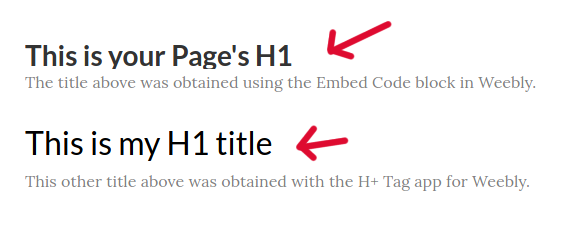
As you tin come across in the screenshot below, we experimented with both workarounds (the Embed Code element and the H+ App) and this was the result:
H1 Tags in Wix
There are 2 ways to create an h1 header in Wix.
If you're working on your web log:
- Click Add on the left side console
- Click HTML Code at the cease of the list of options
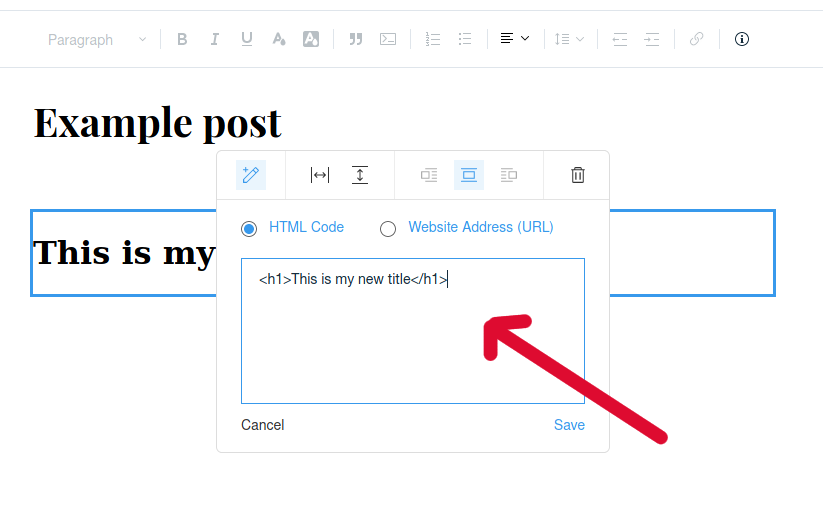
- Write <h1>This is my new title</h1> in the HTML field that appears, changing the text within the <h1> … </h1> tags with your own title
- Click Save
See the screenshot beneath:
If you want to edit your h1 header, just click on information technology and the HTML field will appear again.
To add an h1 header to your site pages, go to your Dashboard and click Site actions -> Edit Site from the heart panel.
When you're in the Wix Website Editor:
- Choose your page from Pages on the left side toolbar or create a new ane
- Click Add together on the left side
- Click Text -> Themed Text -> Add together Heading ane
- Click Edit Text
- Edit the text to include your title. You can also adjust its size and font
- Drag and drop your new title to your preferred position on the page
To edit this h1, click on information technology and and then on the Edit Text button that appears above your title.
You tin can find more than information and screenshots in this Wix support page.
H1 Tags in WordPress
WordPress makes things very easy when information technology comes to formatting titles and paragraphs in a page or mail.
In fact, you can add and edit all your headings right in the mail editor.
Now, at that place's a difference in how you lot do that depending if yous employ WordPress' Classic Editor or the Gutenberg Editor.
For the Classic Editor, all y'all have to do is open the drib-down menu on the Paragraph item on the carte du jour bar and cull "Heading one" among the heading options.
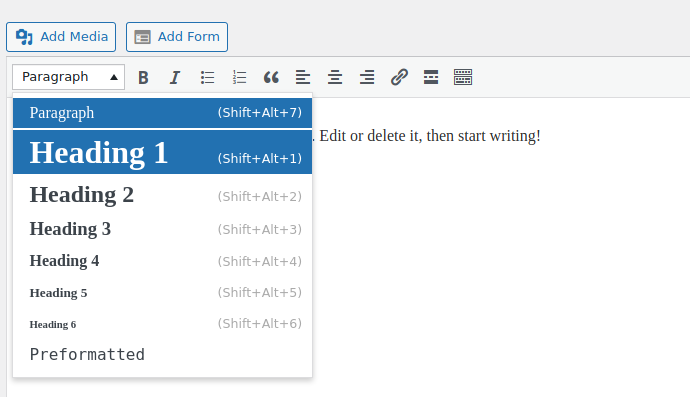
If yous have yet to write the title, click on "Heading 1" and and then write your title. If you have already written the title, select it with your mouse and then choose "Heading 1" from the card.
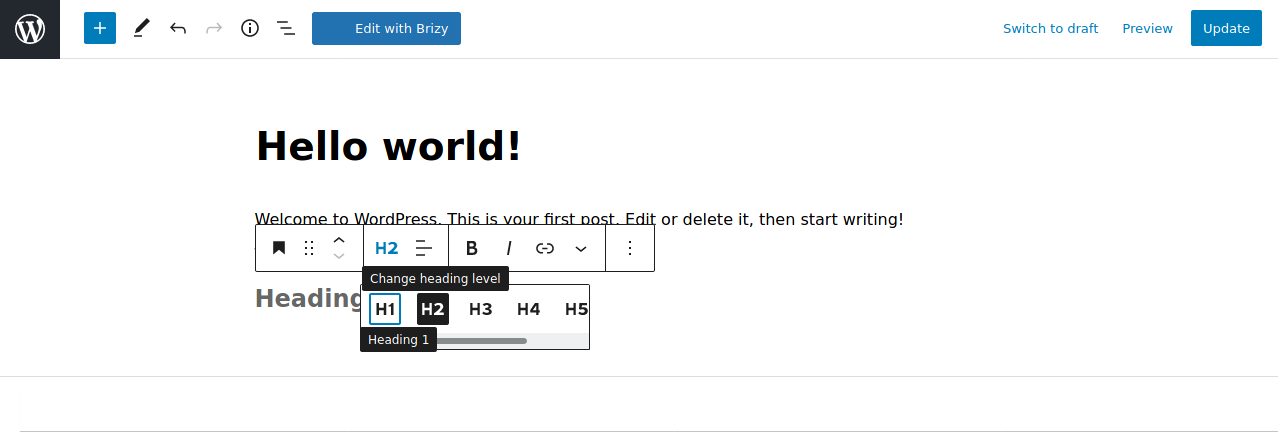
If y'all utilize the Gutenberg Editor, you have to click the blue "+" button at the top left of your post/folio editor to open the block inserter. In the window that opens, click "Heading" and then click on the "Heading" text that appears on your mail/page.
This heading is mostly an h2 and you can see this because, later on you lot clicked on the "Heading" text, an options bar appears and says "H2".
All you have to do at present is click on that "H2" in the options bar and then select "H1" from the heading options that you are shown. See the screenshot below:
H1 Tags in Squarespace
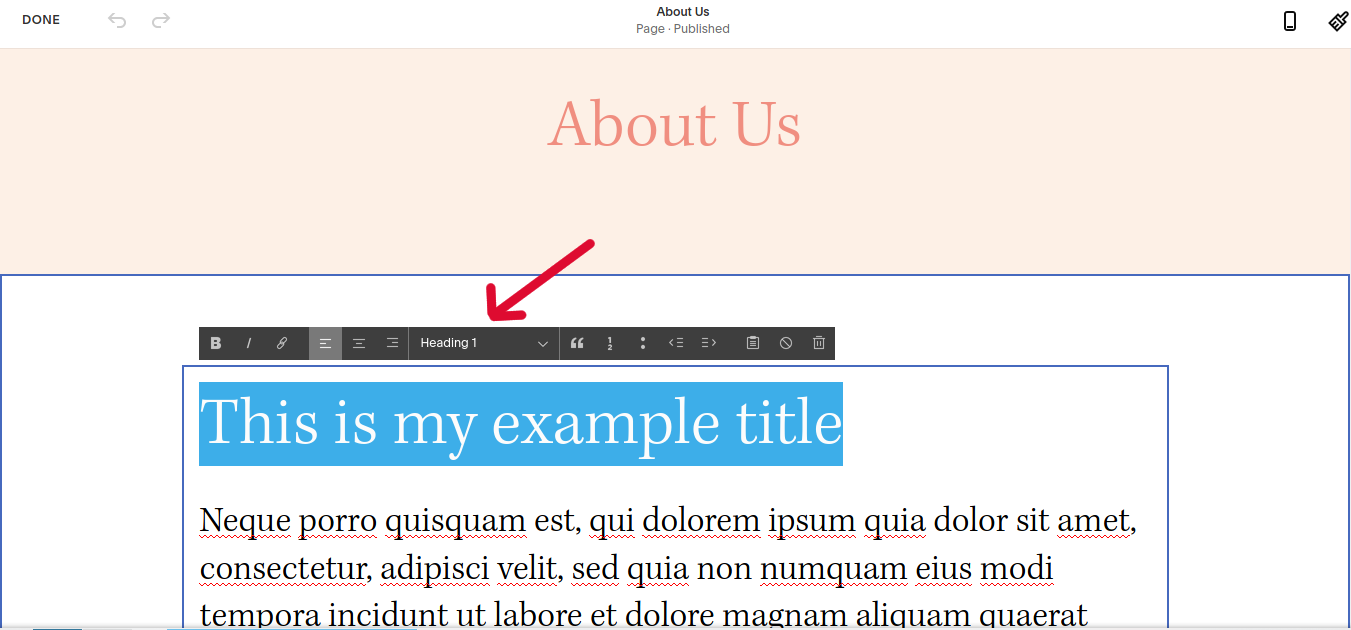
Creating h1 headings on Squarespace is pretty simple:
- Choose your folio under Chief Navigation
- Click the Edit button at the meridian
- Write your heading text in the torso of the folio (or select it if y'all've already written it)
- Choose "Heading ane" from the drop-downward bill of fare
Run across the screenshot beneath:
Sure templates on Squarespace add h1 tags to your pages and posts automatically, and due to this your site can accept more than one of the same tags. This is only because of the way those templates are set upwards.
All the same, this is no problem at all! In fact, Squarespace has said that while multiple h1 tags make some users nervous, they should residue bodacious that it volition not take a negative upshot on SEO if they are correctly used (that is, to highlight different sections on a Folio or Mail).
H1 Tags in Shopify
When you lot add a new product in Products -> Add production, you can add an h1 heading to your product description past clicking the "<>" push on correct side of the description box and writing the HTML lawmaking for the h1 heading:
<h1>This is an case championship</h1>
See the screenshot below for an instance:
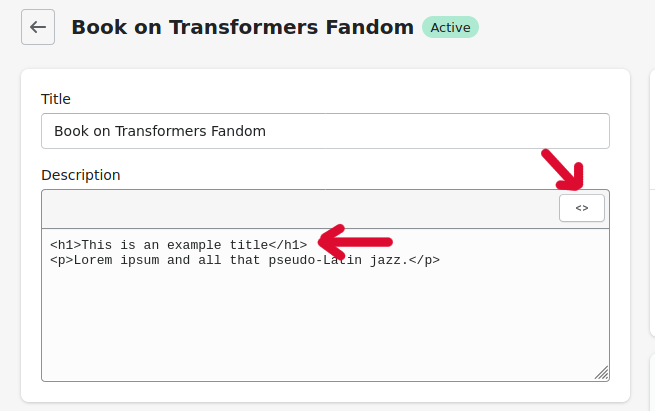
It'southward also worth noting that your production Title volition automatically convert to an h1, and so you'd follow these instructions if y'all wanted to add together an additional h1.
Please go on in mind that any further h1 headings in your shop's theme tin only be edited through the theme editor (Online Store -> Themes -> Customize) and you lot can't add together headings to the theme manually.
H1 Tags and SEO: Best Practices
1. Don't stuff your heading tag with keywords
Google hates that, and it doesn't help readers either.
Incorporate keywords naturally in your heading just the same way you do with your post or page text.
Effort to not utilize more than one h1 tag on a folio, merely every bit we said, having more h1s doesn't put you lot in trouble with Google, so don't worry if you can't help information technology, as in the case of certain templates, where this is beyond your command.
Just brand certain your headings work every bit titles and dividers to different sections and not just randomly interspersed within your page or post.
ii. Don't make <h1> the same equally your page title
Unless it makes sense to echo your <title> tag in your h1 heading (for example, when y'all want to have your web log post championship in both the <title> and the heading), attempt to not go far the same as your page title, aiming to vary the use of your focus keywords and to better inform the reader about your content.
A good rule of pollex is to make your h1 header text consistent with that of the <title> but not identical.
3. Always have an <h1> tag on your page
If the <h1> tag is missing on your page, search engines can and will use whatever available heading they find on your page, which means they volition take the h2, h3, h4 , h5 or h6 tags as the page'south championship (and therefore as the title that's representative of the whole folio's content).
Make certain yous take at least ane h1 header on your page and that this gives users data about your content.
Want to see what you lot need to do to optimize your h1 headers? Login to marketgoo at present!
dickensoninforent.blogspot.com
Source: https://www.marketgoo.com/blog-post/h1-tags-how-to-weebly-squarespace-wix/
0 Response to "How to Upload Several Blog Posts Together Wix"
Post a Comment