What Radioactive Material Is the Main Fuel Used to Produce Nuclear Energy?
Nuclear power plants generate electricity past using controlled nuclear fission concatenation reactions (i.due east., splitting atoms) to estrus water and produce steam to power turbines. Nuclear is oftentimes labeled a "clean" energy source considering no greenhouse gases (GHGs) or other air emissions are released from the power plant. Equally the U.Due south. and other nations search for low-emission energy sources, the benefits of nuclear power must exist weighed against the operational risks and the challenges of storing spent nuclear fuel and radioactive waste.
Nuclear Energy Use and Potential
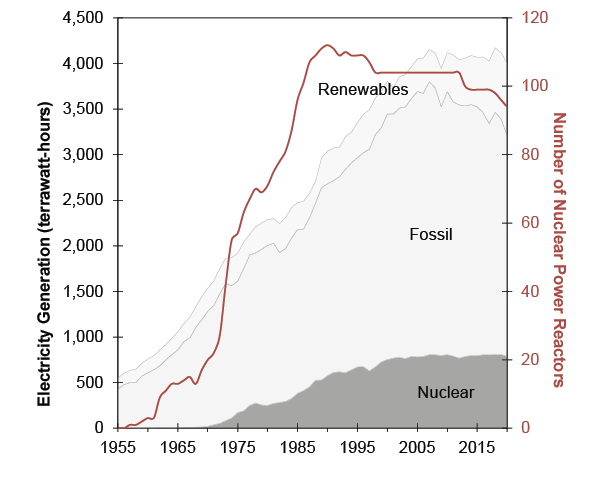
- Nuclear energy provides about 20% of U.Southward. electricity, and this share has remained stable since effectually 1990. Nuclear power plants had a capacity factor of 92.5% in 2020.one
- The kickoff U.S. nuclear ability constitute began commercial operations in 1958.2 During the 1970s, more than l nuclear reactors went online.1 Presently, 28 states have at to the lowest degree i nuclear plant and 32 plants have two or more than reactors.2 Since 1995, U.South. nuclear electricity generation has grown despite no new reactors and fifteen shutdowns, due to higher utilization and uprating of existing plants.1,2
- 667 reactors have been built worldwide since the get-go was built in 1954 in Obninsk, Russian federation, though currently, at that place are simply 443 in operation, 93 of which are in the U.S.three,4 As of May 2021, 55 reactors were under structure, including 4 in the U.S. and eighteen in China.4
- In 2018, the U.S. generated nearly a third of the earth's nuclear electricity. Countries generating the side by side largest amounts of electricity using nuclear were French republic, China, and Russia.v
- Pressurized Water Reactors (PWR) and Humid Water Reactors (BWR) are the virtually common technologies in employ.6 2-thirds of U.S. reactors are PWRs.7
- Levelized cost of energy (LCOE) includes the lifetime costs of edifice, operating, maintaining, and fueling a power establish. Estimated LCOE for plants built in the near futurity are: combined cycle natural gas: iii.71 ¢/kWh; advanced nuclear: vi.31 ¢/kWh; and biomass: 8.92 ¢/kWh.8
U.S. Electricity Generation past Source1
Nuclear Fuel
- Well-nigh nuclear reactors utilise "enriched" uranium, meaning the fuel has a higher concentration of uranium-235 (U-235) isotopes, which are easier to split to produce energy. When information technology is mined, uranium ore averages less than 1% U-235.9
- Milling and enrichment processes shell the ore, use solvents to extract uranium oxide (U3Oviii, i.e., yellowcake), and chemically convert information technology to uranium hexafluoride (UFhalf-dozen), which is enriched to increment the U-235 concentration in the fuel. Finally, a fuel fabricator converts UFhalf-dozen into UO2 powder that is pressed into pellets with three%-5% U-235 concentrations.10
- Uranium tin be enriched by gaseous diffusion or gas centrifuge. Both concentrate the slightly lighter U-235 molecules from a gas containing more often than not U-238, the former with membrane filters and the latter past spinning. Other technologies are currently in evolution, with laser enrichment processes closest to commercial viability.11
- In 2019, 79 metric tons (mt) of U3Oviii were extracted from six mines in the U.S.12 The highest grade ore in the U.Due south. boilerplate less than 1% uranium, some Canadian ore is more than xv% uranium.13,14
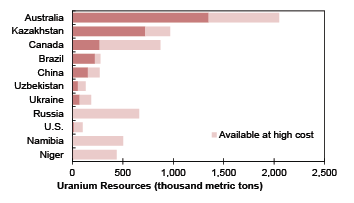
- 1% of uranium available at reasonable toll is institute in the U.Southward. The largest deposits are in Commonwealth of australia (28%), Kazakhstan (15%), Canada (9%), and Russian federation (8%).14 U.S. nuclear plants purchased 22,135 mt of uranium in 2020. Fuel was imported generally from Canada (22%), Kazakhstan (22%), Russia (15%) and Australia (11%).xv
- Globally, nuclear power reactors are forecast to require 68,269 mt of uranium in 2021.four
Fission of Uranium-235 in a Nuclear Reactor

Largest Identified Uranium Resourcesxiv
Energy and Ecology Impacts
The nuclear fuel cycle is the entire process of producing, using, and disposing of uranium fuel. Powering a one-gigawatt nuclear plant for a yr can require mining 20,000-400,000 mt of ore, processing information technology into 27.6 mt of uranium fuel, and disposing of 27.half-dozen mt of highly radioactive spent fuel, of which xc% (by volume) is depression-level waste, 7% is intermediate-level waste, and 3% is high-level waste product.16,17 U.S. plants currently use "once-through" fuel cycles with no reprocessing.18,19
- A uranium fuel pellet (~ane/2 in. height and diameter) contains the energy equivalent of one ton of coal or 149 gallons of oil.10 Typical reactors concur xviii million pellets.6
- Each kWh of nuclear electricity requires 0.i-0.three kWh of life cycle energy inputs.twenty
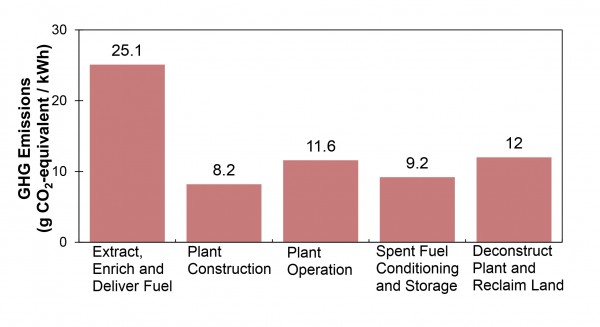
- Although nuclear electricity generation itself produces no GHG emissions, other fuel bike activities practice release emissions.21
- The life cycle GHG intensity of nuclear ability is estimated to be 34-lx gCO2east/kWh—far below baseload sources such every bit coal (1,001 gCO2eastward/kWh).21,22
- Nuclear power plants eat 270-670 gallons of water/MWh, depending on operating efficiency and site weather condition.23
- Uranium is mostly extracted by open pit mining (xvi.one%), hole-and-corner mining (twenty%) and in-situ leaching (ISL) (57.4%).fourteen ISL, the injection of acidic/element of group i solutions underground to deliquesce and pump uranium to the surface, eliminates ore tailings associated with other mining but raises aquifer protection concerns.24
- ISL standards were initially instituted in 1983, and accept been amended multiple times since, nigh recently in 1995.25
Uranium Fuel Bicycle16

Life Bike GHG Emissions of Nuclear Power26
Nuclear waste
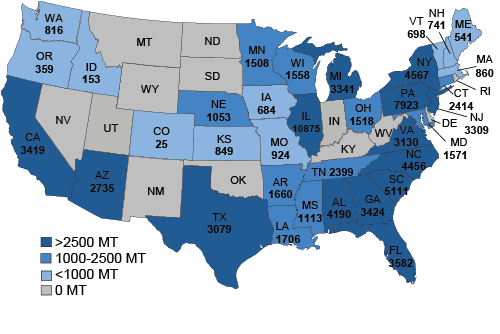
- The U.S. annually accumulates about two,000 mt of spent fuel.27
- During reactor operation, fission products and transuranics that absorb neutrons accumulate, requiring a third of the fuel to exist replaced every 12-18 months. Spent fuel is 95% non-fissile U-238, 3% fission products, 1% fissile U-235, and i% plutonium.sixteen
- Spent fuel is placed in a storage pool of circulating cooled h2o to blot heat and block the loftier radioactivity of fission products.28
- Many countries, though not the U.S., reprocess used nuclear fuel. The process reduces waste and extracts 25-30% more energy than non-reprocessed fuel.19
- Many U.S. spent fuel pools are reaching capacity, necessitating the use of dry cask storage. Dry casks, large concrete and stainless steel containers, are designed to passively cool nuclear waste and withstand natural disasters or large impacts. In 2011, 27% of spent fuel was held in dry casks, after sufficient cooling in storage pools.29
- Currently, 34 states have complexes designed for interim storage of spent nuclear fuel, or Independent Spent Fuel Storage Installations (ISFSI).30
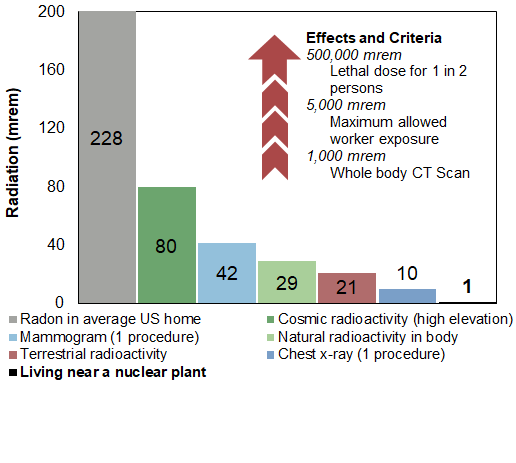
- Ten years after apply, the surface of a spent fuel assembly releases 10,000 rem/60 minutes of radiation (in comparison, a dose of 500 rem is lethal to humans if received all at once).xviii Managing radioactive waste requires very long-term planning. U.S. EPA was required to gear up radiation exposure limits in permanent waste storage facilities over an unprecedented timeframe—one 1000000 years.31
- The U.S. has no permanent storage site. Nevada's Yucca Mountain was to hold seventy,000 mt waste, just is no longer nether consideration, mostly due to political pressure level and opposition by Nevadans.32,33
- The Nuclear waste Policy Act required the U.S. federal government to brainstorm taking command of spent nuclear fuel in 1998. When this did non occur, the government became liable for the costs associated with storage at reactor sites.34
Spent Commercial Nuclear Fuel, Metric Tons 40
Safety and Public Policy
- In 1986, a series of explosions occurred at the Chernobyl power plant in Ukraine. Pieces of the reactor were ejected high into the atmosphere. The loss of h2o in the reactor allowed the fuel to heat to the point of cadre meltdown. 134 workers and emergency responders were diagnosed with astute radiation syndrome and 28 died inside weeks.35
- On March 11, 2011, a magnitude 9.0 earthquake occurred near Fukushima, Japan. The resulting tsunami damaged the reactor cooling arrangement, leading to 3 meltdowns and hydrogen explosions. No deaths or radiation sickness have been directly linked to the blow.36
- The U.S. Price-Anderson Human action limits the liability of nuclear constitute owners if a radioactive release occurs to $450 one thousand thousand for individual plants and $xiii.v billion across all plants.37
- Incentives for new nuclear plants include insurance against regulatory delays, a product tax credit of one.eight¢/kWh of electricity generated and $10.nine billion for federal loan guarantees.38,39
Natural and Human being-Made Exposures to Radiations 41
Cite as:
Center for Sustainable Systems, Academy of Michigan. 2021. "Nuclear Energy Factsheet." Pub. No. CSS11-xv.
dickensoninforent.blogspot.com
Source: https://css.umich.edu/factsheets/nuclear-energy-factsheet
0 Response to "What Radioactive Material Is the Main Fuel Used to Produce Nuclear Energy?"
Post a Comment